LoginRequest Account
// Infrastructure

Built in the
house

MYRA did not licence a core banking platform and put a brand on it. Bedrock — the ledger, the console and the member portal — is written and operated by MYRA's own engineers, which is why the bank can change how it works without asking a vendor for permission.
// Bedrock

One ledger,
no seams

Most private banks run a licensed core, a separate payments layer, a separate custody system and a reporting tool that reconciles them overnight. Every seam is a delay and a place where the numbers can disagree. Bedrock is one system, and every member position lives in one place.
01

Double-entry at the core

Every movement is a balanced pair of entries against named ledger accounts. Balances are never stored and updated — they are derived from the entries, so a balance cannot drift away from the history that produced it.

02

Append-only audit trail

Nothing is edited or deleted. A correction is a new, signed entry that references the one it reverses, with the actor, the timestamp and the reason attached. The trail can be replayed from the first entry to any point in time.

03

Four-eyes by construction

Bookings above policy thresholds cannot settle on a single signature. The approval is part of the transaction, not a workflow bolted beside it, so an unapproved entry has no path into the ledger.

04

Written by the people who run it

The engineers who build Bedrock sit inside the bank. There is no vendor roadmap between a regulatory requirement and the change that satisfies it, and no third party holds the source of MYRA’s books.

// The Portal

What the
member sees

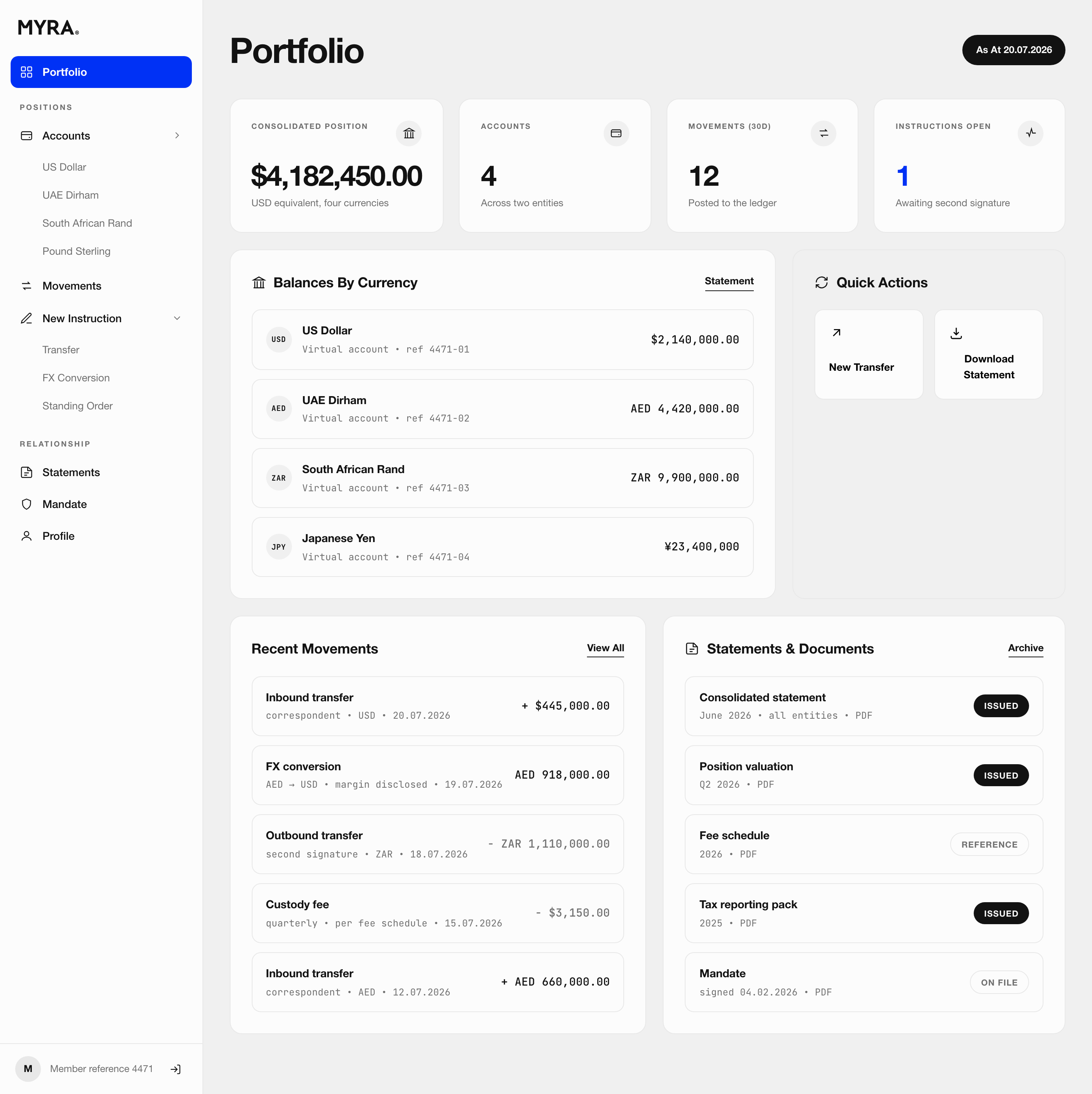
A member is not sent a report about the bank’s records — the portal reads the ledger itself. Balances, movements and a consolidated statement across accounts, entities and currencies, drawn from the same entries the bank books against, with no overnight reconciliation in between.
Member portal — consolidated position
Member portal — consolidated position illustrative interface. All figures, counterparties and references shown are sample data. They do not represent a live account, an actual balance or a real member, and no real client information appears anywhere on this page.
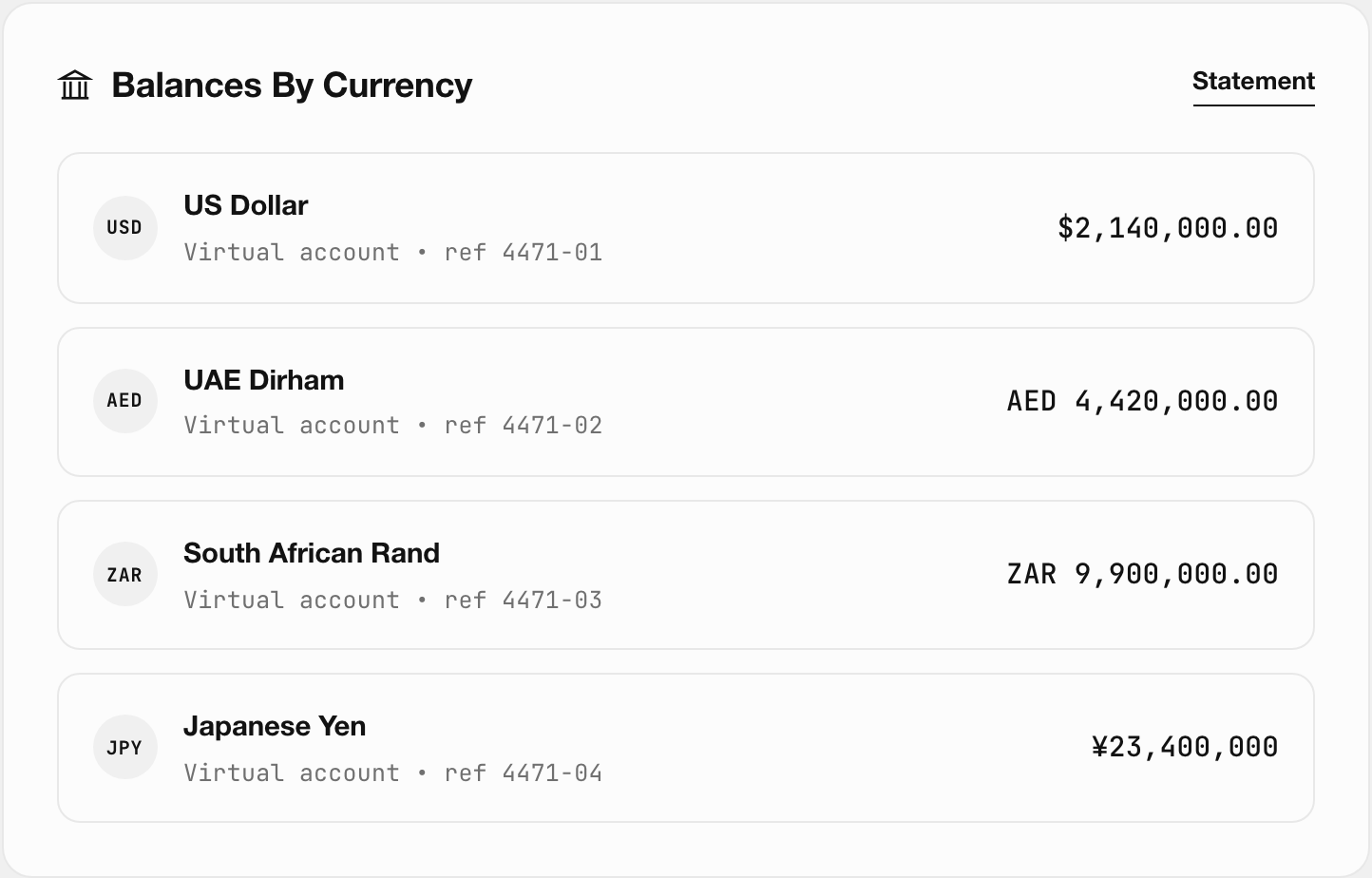
Balances across currencies
Balances across currencies illustrative interface, sample data.
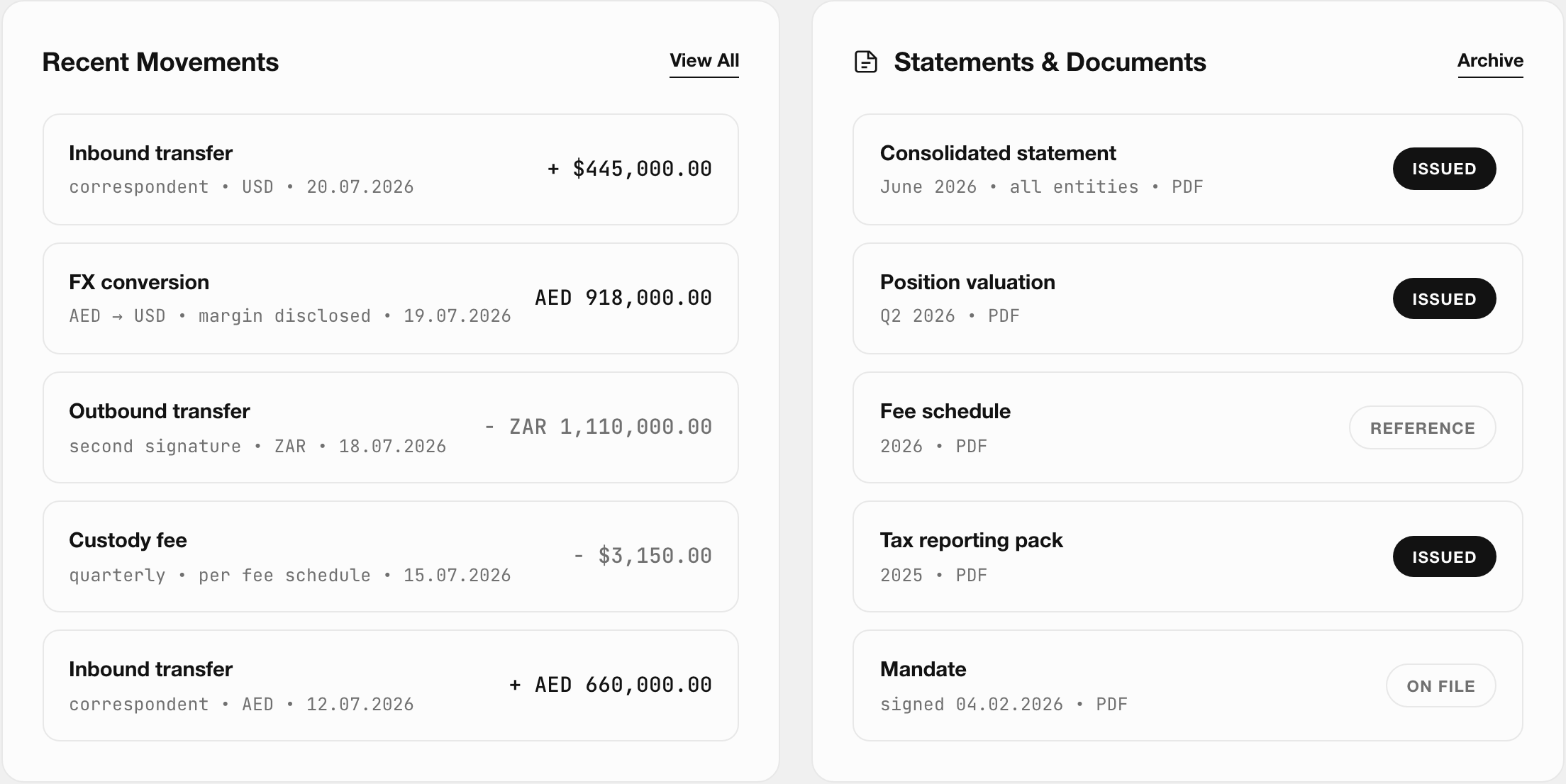
Movements and statements
Movements and statements illustrative interface, sample data.
// Capabilities

What the system does

01

Multi-currency accounts

Balances recorded in USD, AED, ZAR and JPY side by side on one ledger, with virtual account references issued through MYRA’s correspondent institutions and the FX margin disclosed on every instruction.

02

Bookings and approvals

Double-entry bookings with policy-driven limits, a second-signature queue and a full record of who approved what, when and on what basis.

03

Reconciliation

Incoming bank movements are matched against expected receipts, with unmatched items held in a visible queue rather than absorbed silently into a balance.

04

Onboarding and screening

Identity, beneficial ownership, source-of-wealth evidence, sanctions and PEP screening handled in the same system that holds the relationship, so the file and the ledger never disagree about who a member is.

05

Funding and correspondents

Correspondent accounts, funding routes and settlement instructions modelled explicitly, so it is always answerable where a given balance physically sits.

06

Member portal and reporting

Members see the same ledger the bank sees — balances, movements and a consolidated statement across accounts, entities and currencies.

// Operations

Boring on purpose

A member never experiences infrastructure. They experience a number that is right, an instruction that is honoured, and a record that is still legible years later — which is what the three below are for.

One balance

The figure in your statement is the ledger’s own, not a nightly copy of it. When your banker quotes a balance on the phone, they are reading the same line you are.

Every instruction answered

Each instruction carries who gave it, when it was received and what became of it. You can ask what happened to a payment and be shown, rather than reassured.

A record that keeps

Positions, instructions and statements are retained in full and restores are tested, not assumed. A statement you cannot reproduce in five years was never a record.

Private by invitation

See the Bank Work